
Dynamic Strategy: A Practical System for Execution & Governance
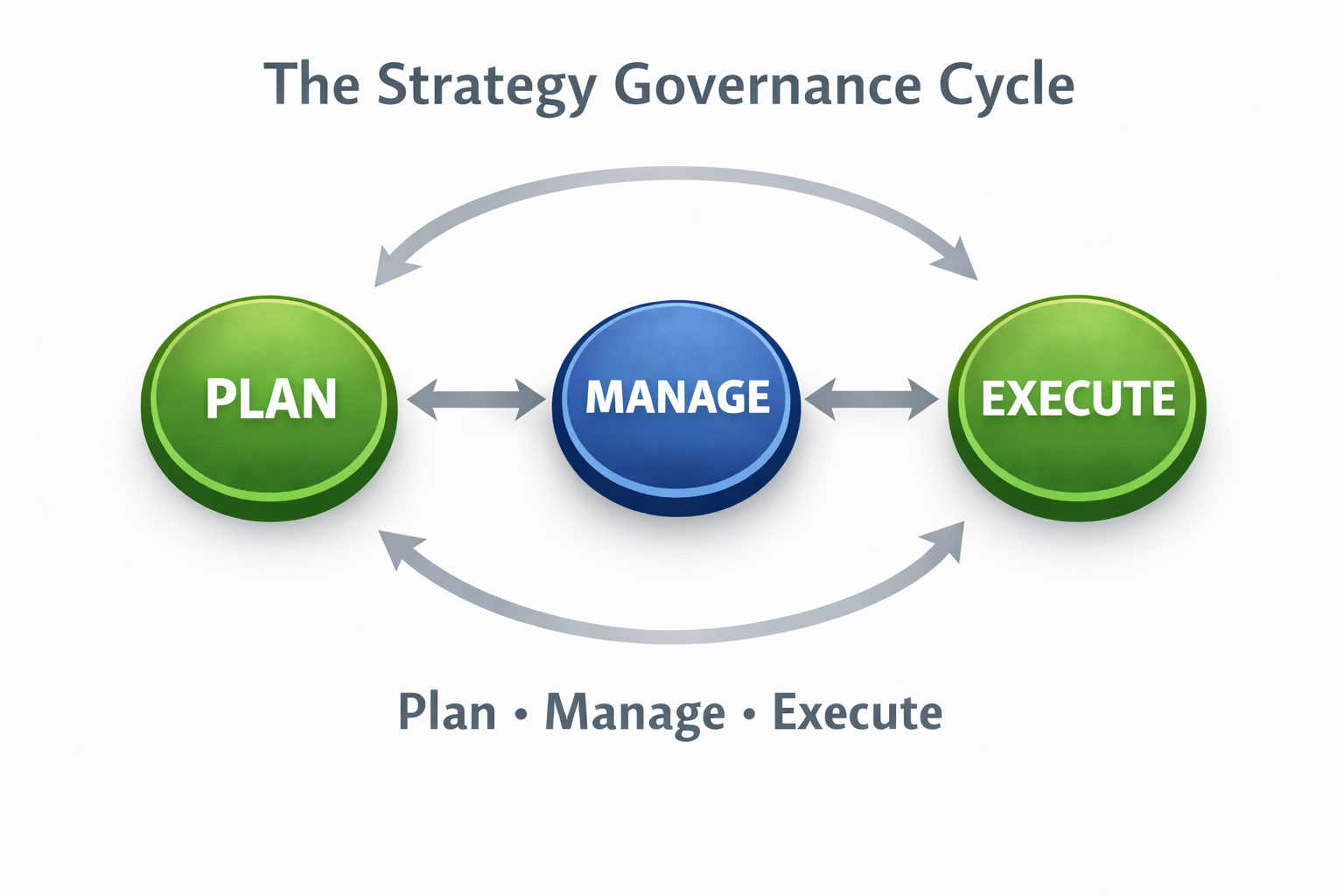
Strategy Governance Cycle: Where Strategy Becomes Disciplined Execution
Most organizations do not fail because they lack vision or ambition. They fail because strategy becomes static and execution drifts. Traditional three-to-five-year strategic are dead on arrival. Markets evolve. The business environment is changing as they are written. Team members come and go shifting priorities.
Yet many organizations continue treating strategy as a planning event instead of a continious leadership responsibility.
Strategy is not a document, it is not a meeting and it is not an annual exercise. Strategy is a living system. And living systems require active governance. This is why our Strategy Governance Cycle is critical to sustainable growth and scale.
What Is the Strategy Governance Cycle?
The Strategy Governance Cycle is a disciplined leadership model that keeps strategy alive, everyone accountable, and execution as the focus through a continuous rhythm of:
Planning → Managing → Executing
Instead of treating strategy as something leaders define once and then mostly ignore, the Strategy Governance Cycle ensures leadership continuously governs movement, evaluates reality, adapts intelligently, and sustains forward progress.
This shifts the concept of strategy to be dynamic by design rather than static by practice.
Plan: Establishing Direction with Clarity
Planning begins with defining intentional objectives and potential pathways forward. The goal is set and the path assumed. Plannings objective is establishing clarity, alignment, and directional confidence.
Great planning accepts a reality many leaders resist:
- Plans will change.
- Assumptions will evolve.
- Conditions will shift.
Good leaders create direction. Expert leaders maintain direction when obstacles arise. The Strategy Governance Cycle treats planning not as a one-time, one-direction declaration, but as an actively engaged leadership responsibility.
Manage: Governance Is Where Most Objective Break Down
This is the difference between companies that make progress and companies that stall.
Plans do not work because they exist. They work because they are well managed and governed. Managing strategy means leadership remains actively engaged in stewarding momentum, not the results after the fact.
Effective strategy governance requires:
- Continuous visibility into progress
- Meaningful discussion initiative feedback
- Adaptation when necesary
- Clear communication
- Real accountability
This is where leadership maturity is tested. Governance is not bureaucracy. Governance is stewardship of motion. Without governance, strategy becomes hopeful documentation. With governance, strategy becomes disciplined execution.
Execute: Move, Learn, Adjust, Advance
Execution is not about forcing work forward. It is about moving decisively, learning intelligently, and adjusting thoughtfully towards the objective. The purpose of execution in the Strategy Governance Cycle is simple:
Achieve the objective or learn fast enough to refine the approach intelligently.
Success informs the plan. Failure create an evaluation of the plan. Iteration strengthens the objective. Execution is not the end of the process, it feeds the next cycle of planning and management.
This is how an organization can maintain progress without losing their strategic intent.
How the Strategy Governance Cycle Integrates with Foundational Thinking & The SIMPL Method
The Strategy Governance Cycle is not an isolated model. It fits intentionally into a broader three-piece leadership architecture.
Foundational Thinking
Gives leaders clarity, principle-based thinking, and a disciplined way to shape decisions.
The SIMPL Method
Aligns the organization around the three core performance engines: Brand, Operations, and Product.
The Strategy Governance Cycle
Ensures strategic direction, accountability, and execution remain continuously governed through: Planning, Managing, and Execution.
When brought together they create a comprehensive leadership system that is:
- Structured
- Practical
- Scalable
- Sustainable
This is not theory. This is fundimental to how successful organizations run.
Why the Strategy Governance Cycle Works
The Strategy Governance Cycle is a powerful tool because it is:
- Simple enough to adopt quickly
- Mature enough to work at enterprise scale
- Clear enough for leadership teams to align on
- Disciplined enough to prevent drift
- Flexible enough to adapt without chaos
No matter how complex the organization becomes, the cycle and rhythm of leadership remains the same:
Plan.
Manage.
Execute.
Final Thought
Strategy does not fail because due to a lack of planning. It fails because leaders do not continuously govern the plan. Organizations that adopt the Strategy Governance Cycle do not merely survive change, they are built to thrive in it.
This is how we give meaning to strategy and how it evolves through disciplined execution. This is how we can lead and curate sustainable growth in our companies. This is how we grow.